



By Pete Mecca
Born and raised in Cajun country, Alan Gravel received a degree in Civil Engineering from Louisiana Tech before obtaining a Master’s Degree in Environmental Health Engineering at the University of Texas.February of 1969 launched 23 year old Gravel into officer training on the Medina Campus at Lackland AFB in San Antonio, Texas. He recalled, “I wanted to fly, so the Air Force sent me to Laughlin, AFB in Del Rio, Texas to see if I could qualify. The first aircraft a trainee had to master was the T-41 Mescalero, a military version of the Cessna 172.”
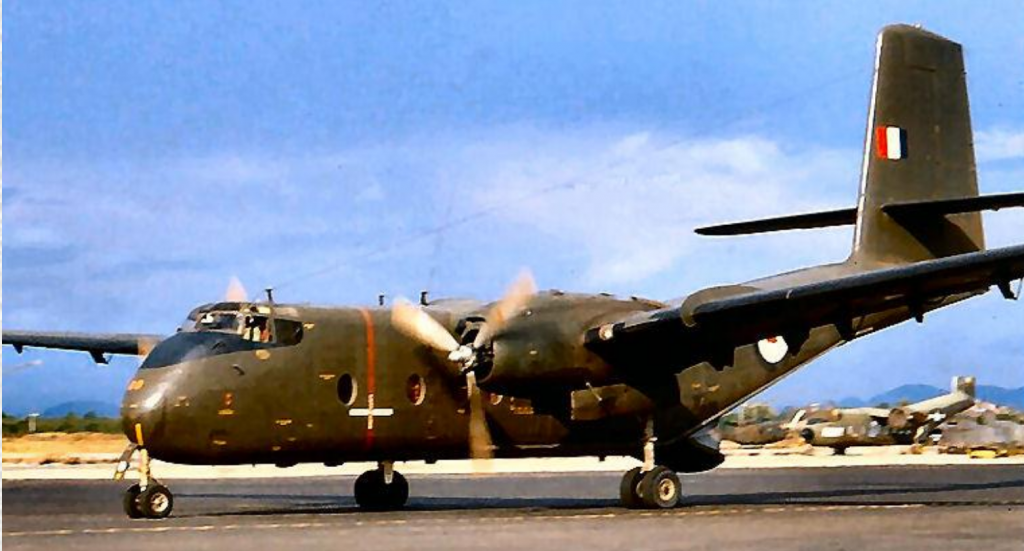
Once qualified on the Mescalero, Gravel sat behind the controls of the T-37 Tweet jet trainer before moving up to the supersonic T-38 Talon. “The training took a year,” he said. “Then I was sent to Abilene, Texas for training on the DeHavilland Canada C-7 Caribou. The Caribou was a STOL aircraft, Short Takeoff and Landing. I attended survival school in Spokane, advanced survival school in the Philippines, and flew into Cam Ranh Bay, Vietnamin September of 1970.” Deemed an orphan child of aviation, the Caribou has not received the recognition it truly earned in Vietnam. First purchased by the U.S.Army, the U.S. Air Force took over the Caribous in 1967 whilst transferring most of their choppers to the Army.
The Air Force had been using Caribous for two years by the time Gravel set foot in Vietnam. He recalled, “I joined the 536thSquadron. I flew copilot before earning the pilot’s seat. We’d fly into Bien Hoa for a seven day stage, meaning we’d fly out of there for three days, get one day off, two more days of flying, then back to Cam Ranh. We flew a three day stage mission out of Can Tho but no days off. The Caribou served 75 airfields where no other fixed-winged cargo airplane could go.” Recalling his C-7 training in Abilene, Gravel said, “Our instructors told us, ‘You’ll be shot at, land on awful airfields, deal regularly with tough situations like finding a live hand grenade on your aircraft, but it is the weather that will kill you.’ Well, they weren’t lying. To do our job in Vietnam we had to do things on the dangerous side, like flying too low, through dense clouds or thick fog, and if on instruments there was the danger of smacking into the side of a mountain. Then you factor in the airfields. A Caribou needs about 1200 of runway, and that’s short, but one Special Forces airfield was 900 feet long and 40 feet wide. If you’re going in with a full load, that’s pretty tight.”
Gravel’s aerodrome directory described the crude Dak Pek airfield thusly: “A Caribous wing will clear the hill as long as your wheels are centered on the asphalt.” Gravel said, “That meant stay in the center or else!” The airfield at Dak Seang was nicknamed ‘the ski slope’. Gravel explained, “The airstrip resembled a hunchback snake; it had a size able dip in the middle, like a small valley. You couldn’t see ‘down in the ‘valley’ from either end of the airfield. Some runways had roads running across the middle, and some roads were used for runways.”
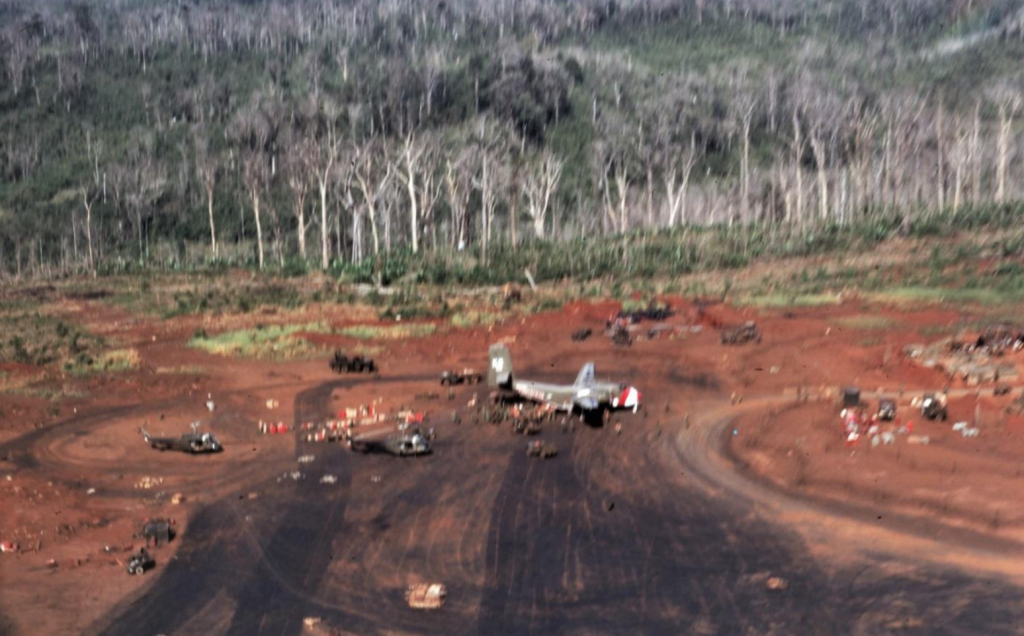
Advised to fly at 3,000 feet to avoid ground fire, Gravel said, “I believe that’s the only thing we did by the book. We were taught that if you’re coming in to land and things don’t look right, then ‘go back around’ to try again. Not in Vietnam. To ‘go back around’ you had to add power, which meant you make a lot of noise which attracts a lot of attention. You would be basically telling the bad guys, ‘Okay, we’re going to give you guys enough time to set up your mortars.’ No way. I had flown with a real cocky, but skillful, pilot who taught me a terrific tactical approach. You come over the runway as slow as possible,put down your landing gear then spiral down from 3,000 feet. You roll out at 1,000 feet, run up the engines enough to set propeller RPMs for a ‘go around’ if ever necessary, then back to idle with flaps down. With enough experience we didn’t even have to touch the throttle, basically landing with a dead stick. We’d receive small arms fire, but didn’t realize it until we landed and even then someone had to tell us.”
The tough little Caribou conquered crude airfields at Song Be, Du Dop, Thein Ngon, Katum, Loc Ninh, and Djamap. Gravel recalled, “One pilot landed in the wrong place and didn’t have the room to get back out. A Sikorsky S-64 Skycrane was called in to lift him out. Well, they hooked up the Caribou, got airborne then dropped it. The Caribou was a total loss.” Caribous were used for ‘maintenance alerts’ at Cam Ranh Bay. “We had a Caribou loaded and ready to go,” Gravel said. “When a Caribou broke down out in the boonies, the maintenance Caribou would fly to them, swap planes so the original crew could complete their mission while the maintenance team and crew waited for the downed Caribou to be repaired. On one maintenance mission to Ban Don, we found a Green Beret advisor who had been waiting 3 days for extraction back to Nha Trang. We repaired the Caribou then gave the poor guy a hop back to his base. The incident reminded me why I didn’t join the Army!”
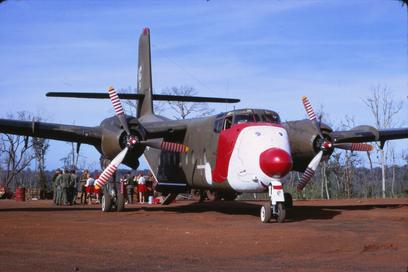
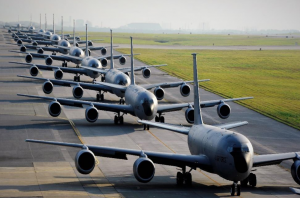
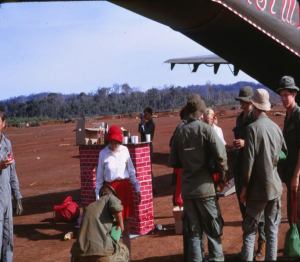 Caribou to Santabou: On Christmas Day each squadron painted a Santa Clause face on a Caribou. The radome, a round radar apparatus on the nose of a Caribou, was a perfect Santa’s nose when painted red. Gravel recalled, “I remember Christmas Day, 1970. We were flying to Djamap when I heard a Santabou pilot calling ground control, ‘Djamap, this is Santabou 420inbound for landing.’ Well, that totally bewildered the Army guy on the ground. He finally replied, ‘Uh, yeah….okay,’ then the radio fell silent. He’d never heard of a Santabou. I radioed in minutes later, ‘Djamap, this is Iris 416, inbound for landing.’ The Army guy came back instantly, ‘Right, Iris 416! Uh, Iris 416, did you just hear something or someone else on this frequency a few minutes ago?’ I couldn’t lie to the poor guy, so I suggested that he and his buddies get ready to have a good time because a Caribou Santabou was inbound with pretty Donut Dollies, cookies, cakes, eggnog….well, talk about an excited Army man! We touched down after the Santabou and noticed that the ‘good times’ had already started. We never, ever shut down at Djamap, but we did that day!” Surviving his one year tour, Gravel’s next port-of-call was Castle AFB in California for flight training on the KC-135 Stratotanker aerial refueling aircraft. By May of ’72, he was back in the Philippines at Clark AFB and back to war. Gravel: “We’d fly from Clark and set up a 60 mile refueling track called Purple Anchor, just north of Da Nang and along the coast of North Vietnam. We mostly refueled the fast movers (fighters), like the F-4 Phantoms, sometimes individually, sometimes in a flight of four. A tanker pilot I flew with was an ex-fighter pilot and he wasn’t real happy flying tankers, but he sure proved his worth.”
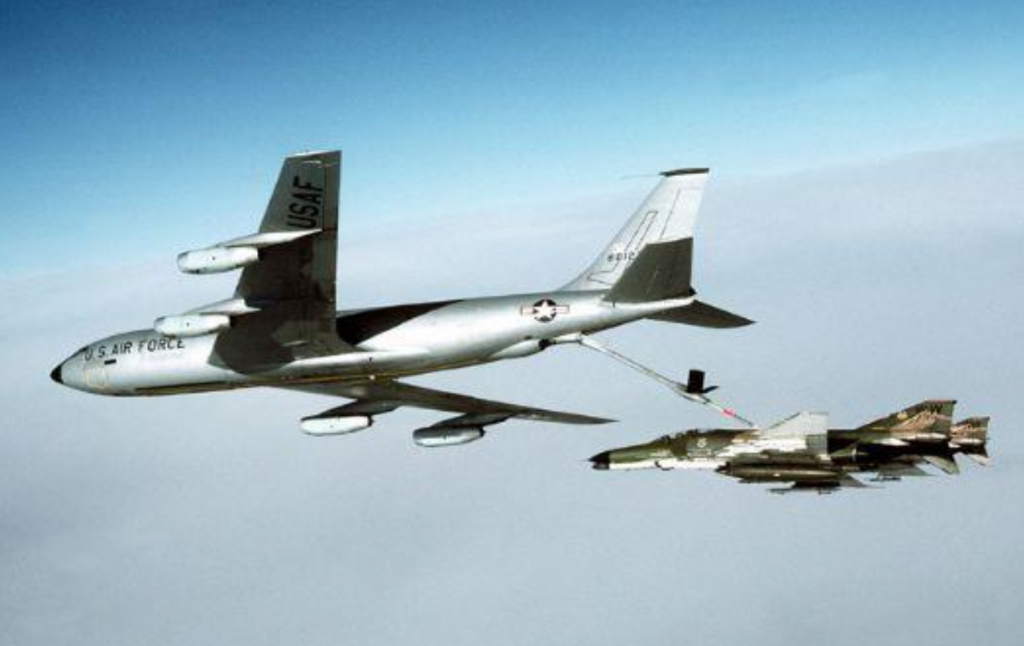
One incident: A Phantom F-4 fighter, shot up and losing fuel, called in a ‘Mayday’ – Gravel recalled: “He was in bad shape and losing fuel so fast we knew he couldn’t make it back to Da Nang. We were his only hope, so went after him,we went inland, something we were ordered never to do. We painted him on our radar screen heading directly toward us so we did a 180 and waited for him.He pulled up to fuel but the boom operator couldn’t connect with his fighter; the latch mechanisms on the Phantom’s receptacle wouldn’t open. We attempted a procedure that is dangerous but doable, applying pressure on him as he puts pressure on us, meaning he’s nudging his aircraft towards us as we nudge ours towards his, with only the refueling boom keeping us apart. I normally used two of the six pumps to refuel; in this case I turned on all six. With that amount of fuel rushing out we were able to blow a portion of fuel past the damaged receptacle to at least replace what he was burning to stay airborne.If the boom had snapped from the pressure we would not have had the time to respond. Both aircraft would have collided in midair. Luckily, he was a great pilot and we had a great boom operator. We flew right over Da Nang and dropped him off. He used up every bit of his fuel landing. We don’t have a clue to his name, his unit, where he was based, nothing. It’s called teamwork, getting the job done.”
 Note: There is at least one other ‘known’ incident during the Vietnam War when a refueling tanker broke the rules of engagement to assist and/or save another aircraft in distress. Breaking rules of engagement can result in a court-martial, but in both cases mentioned, the incident was simply ‘forgotten’.
Gravel continued, “On slow days the tankers on Purple Anchor would stack up. Active refueling at 16,000 feet,tankers on standby at 20,000 and 24,000 and sometime seven 28,000 feet. Chicks (fighters) would come up to refuel until the bottom tanker hit bingo fuel and was force to head home. Then we’d rack down 4,000 feet to the next level; those missions could easily turn into 16 hour ordeals.” Sadly, one KC-135 was lost out of Okinawa during Gravel’s second tour. It simply disappeared, with the formal declaration stating: ‘The cause unknown; lost over the Pacific.’ The copilot was a graduate of North Georgia. His duty done, Gravel left the military and moved to Atlanta so he and his wife could be near family. Using his engineering talents, Gravel eventually started his own business, Willow Construction, completing such projects as the reservoirs for Clayton County and Peachtree City, dam building and repair, and water and sewage facilities. Sadly, the Gravels lost a son to Leukemia in 1980. In conclusion, Gravel stated, “I know it was war, and it may be difficult for people to understand, but I enjoyed my missions, in the Caribous or the tankers. The soldiers in the rice paddies or jungle and the chicks in the air depended on us to do our jobs correctly so they could continue to do theirs. In my opinion, it’s those guys who deserve the recognition and the respect.”
Pete Mecca is a Vietnam veteran. For story consideration visit his website at VETERANSARTICLE.COM and click on “contact us.”





 Vintage Aviation News