



With the Centenary for the end of the Great War, the war supposedly to end all wars, having just passed two weeks ago on November 11th, and with that same date 100 years ago chiseled in time as Remembrance Day ever more, your editor thought that the following article by my great friend Dave O’Malley at Vintage Wings of Canada was important to repeat here on our pages as well. This is a brilliant and dedicated piece of research mapping out, ever so powerfully, the price that victory in WWII demanded from families in just one small neighborhood within the Canadian Capitol. Taken as a small subset of the larger story, this deep dive on the lives cut all-too-short by war within a city square mile can easily be extrapolated to reveal the greater cost across Canada, and no doubt with similarity in the villages, towns and cities in other Allied-aligned nations across the globe, albeit with greater consequences for those states having endured the war since its very beginnings.
O’Malley has not only found the names of 392 servicemen from his neighborhood who paid the ultimate sacrifice in WWII, but even located a representative photograph for almost every man as well. But most poignantly, he also mapped out where each of their families had lived. And it is on that point that in many ways the real sacrifice was laid bare… the irreparable sense of loss that each of these people would have felt for their fallen family member; a loss that would have followed each of them for the rest of their days. Just as heart-breaking to comprehend is that this locale likely paid a similar price a generation earlier during WWI as well. Such was the way of things… here’s to never having the need to create such a map again.

Young men and woman who are killed on active service are said to have paid the “supreme sacrifice”. I guess that is true. There’s not much more that you can give than that. But I posit that the greatest sacrifice of all is borne by the families of those killed in the line of duty. Airmen, soldiers and sailors who die in battle are lionized, and rightly so, but it’s their mothers, fathers, wives and families who are conscripted to carry the burden of that sacrifice to the end of their days.
by Dave O’Malley
Mapping the Fallen
The neighbourhood I live in is called the Glebe. It’s a funky 130-year old urban community in Ottawa, Ontario, Canada— red brick Victorian homes, some stately, some working class, excellent schools as old as the neighbourhood, tall trees pleached over shady streets, open-minded and highly educated people, happy kids, diverse, desirable and timeless, close to everything, surrounded on three sides by the historic Rideau Canal. People come from all over the city, the country, even the world to walk its pathways, attend its festivals and sporting events and skate the canal. You may find a more upscale neighbourhood, a trendier one, a more affordable one, but you will never find a better one.
It is a truly perfect place to raise a family, build a business and live out a life as I have done. It is safe, historic, dynamic, walkable, serene and peaceful… but once it must have felt like the saddest place on earth. Its shady avenues ran with apprehension and despair, its busy serenity masked the constant high frequency vibration of anxiety and the low pounding of sorrow. Behind every door and every drawn curtain hid anxious families. Behind many were broken parents, heartbroken wives, memories of summers past and lost, the promises of a future destroyed, children who would never know their fathers. These were the years of the Second World War and the decades following that it took to wash it all away.
There was nothing particularly special about the Glebe that brought this plague of anguish, nothing it deserved, nothing that warranted a special attention from death. Indeed, the Glebe was not singled out at all, though it may have felt like it. Every community in Canada and across the British Commonwealth took the same punishment, felt the blows to its heart, felt its life blood seeping away. During these six long years of war, every community across the land stood and took it, blow after blow after blow. Parents stood by while their sons and daughters left the family home, left the routines that gave comfort, the futures that beckoned and began arduous journeys that would, in time, lead most to war and great risk of death.
Some would die in training, others in transit. Some would die of disease and even murder. Some would die in accidents close to home, others deep in enemy lands. Some by friendly fire, others by great malice. Many would simply disappear with no known grave, lost to the sea, a cloud covered mountain, a blinding flash, a trackless jungle. Some would die in an instant, others with prolonged fear and pain. Most would make it home again. An extraordinarily high number would not come home in one piece.
Though it was not alone in its sorrow, the Glebe was the first community in Canada to feel a blow. The first Canadian to die in the war, and in fact the first Allied servicemen who died in the war came from here. Pilot Officer Ellard Cummings, a former Glebe Collegiate Institute student, was killed just a few hours after war was declared on September 3, 1939 when the Westland Wallace he was piloting crashed into a mountain in Scotland in fog. The first Canadians to die on North American soil in the Second World War were from Ottawa, including Glebe resident Corporal David Rennie. He was lost in early September of 1939 along with another Ottawa aviator named Ted Doan, when their Northrop Delta airplane experienced an engine failure and crashed into the New Brunswick wilderness while en route to Cape Breton to join in the search for German submarines. He lived with his parents on Ella Street, just a few blocks from my home. They were the first of many, many families in the Glebe whose lives would be destroyed by the war. Their son would not be found for another 19 years.
Over the years, I have written or published many other stories about Canadian airmen during the Second World War. Several have intersected with my neighbourhood. David Rouleau, who lived just north of my home was lost in 1942 at Malta. Lew Burpee, who lived just a few blocks away was killed a year later during the near-mythical Dam Busters Raid on the Ruhr River dams. In that same one-year span, two cousins who lived right across the street from me were lost on operations—Jim Wilson and Harry Healy. Several blocks north, lived Keith “Skeets” Ogilvie, the last man out of the tunnel during the Great Escape. He narrowly escaped being murdered by the Nazis upon his capture.
All these men walked the same streets that I did and still do. I can pass their homes any day, enter their churches, visit their schools. They all went to the Mayfair, Rialto and Imperial Theatres to find out the news about the war or just to escape from it. I still go to the Mayfair to this day. They played hockey on the frozen canal like I used to do. They used the same butcher I use today. This immediacy, this connection is a very powerful thing. It brought home the loss in a very personal way.
When I wrote a story about 617 Squadron Lancaster pilot Lewis Burpee on the 75th Anniversary of the Dam Busters Raid this year, I pinned his and the homes of others I had written about on a map of the Glebe. Seeing these homes and their physical relationship to me and to each other had a very powerful effect on me. In fact, it obsessed me.
I began to wonder how many other stories there were in these streets and avenues. How many more had been lost? How many families were affected? What I found out left me speechless. In the age of the “infographic”, I set out to demonstrate visually what that number of fallen meant to my personal community, by mapping death’s footprints.
I commenced my search by writing to all the churches in the Glebe and surrounding areas that existed in the Second World War and were still in existence today. Following the First and Second World Wars, many churches in Ottawa dedicated large bronze plaques to commemorate those members of their parish who died in the war. I had seen several over the years. Several churches had photos of these plaques on their websites, while others wrote back to me, attaching photos of their plaques.
There were four major public high schools in downtown Ottawa in 1939—Glebe Collegiate Institute, Lisgar Collegiate Institute, Ottawa Technical High School and the High School of Commerce. Of these four, only Glebe and Lisgar still function today—two of Ottawa’s finest schools. In the lobby of Lisgar, I found a bronze plaque with the names of those former students who had died in the Second World War. On the Glebe Collegiate website, I found a list of all those Glebe students who had died. I also found an entire section of Glebe Collegiate’s website where students had researched most of the names from the plaque and had compiled short histories of each of the fallen alumni.
At the end of May, I began my quest to find and map the fallen in the Glebe. To do this, I would have to find the addresses of every young man listed on these plaques and in Casualty Lists published in the Ottawa daily broadsheet newspapers. In the case of the Glebe history project, many of these addresses were part of their research. I cross-referenced every man in every plaque in every church and school with the Canadian Virtual War Memorial site In the hopes of finding their stories, addresses and photos. I also purchased a Newspapers.com membership and began cross-referencing the dates of each man’s death. Though, for privacy reasons, you would never see this today, newspapers almost always included the address of the next of kin. If he was married, both the address of parents and wife could be mentioned. If both were within the boundaries of my map, I used the parental home. I did not map both addresses. Starting with the posted date of the serviceman’s death, I scoured every page of each issue of the Ottawa Journal moving forward until I ran into a story about each person’s loss. Five months into the search, the Ottawa Citizen became available on-line and more fallen became to light. All of the men who qualified were mentioned in one of the hundreds and hundreds of official casualty lists published in both papers. I did not differentiate the manner of their deaths, though most died on active service. A small proportion died of disease, motor accidents, train wrecks and heart attacks, but if they qualified to be on an official casualty list in the local papers and on the Canadian Virtual War Memorial, then they qualified for this map.
If the man died in Canada in training, the story usually appeared in one to two days, but if he died overseas on active service, it could be weeks before his name appeared in a story or on an official casualty list as either missing in action or killed on active service. If a man was missing in action, then his story would appear in the paper again in one of two ways. In a few months, if he was alive, a story would appear informing readers that he was a POW. If he was dead, the wait would be a bit longer, but in six to eight months, another piece would appear in the paper stating that he was, for official purposes, presumed dead. As 1944 turned into 1945, the tone of newspaper stories took a turn for the better. With the war winding down, the airman or soldier’s photo might be accompanied by short headlines like—“Safe in England”, “Liberated”, or “Returning Home”. Still, there was fighting to be done and the Glebe was not out of the woods yet. The killing continued.
In the Glebe as in most urban neighbourhoods at the time, the Grim Reaper took the form of the telegram boy who had the duty to deliver both good and bad news. Mothers, looking out from their front porches, fathers from their parlours, wives from their washing, must have cringed to see the young man from the Canadian National Telegram and Cable Company pedal or drive down their street, and willed them to move on. In all cases, the next-of-kin was informed by telegram before the official casualty lists were published in the paper, but on a few occasions, happy stories (award of medals, a marriage, etc) about a serviceman appeared in the paper after the next-of-kin had been notified of his death. These must have been difficult to read for the parents and families.
My original goal was to map only residents of the Glebe or former students at Glebe Collegiate who were killed or died while on active service. In order to map these men, I needed to extend the map of the Glebe beyond the recognized boundaries of the neighbourhood, as many students of the high school lived outside the neighbourhood. In the end, it seemed the full complete story could not be told unless I mapped each and every one of the fallen—airmen, soldier or sailor—whose next-of-kin resided within the edges of my map, regardless of their connection to the Glebe.
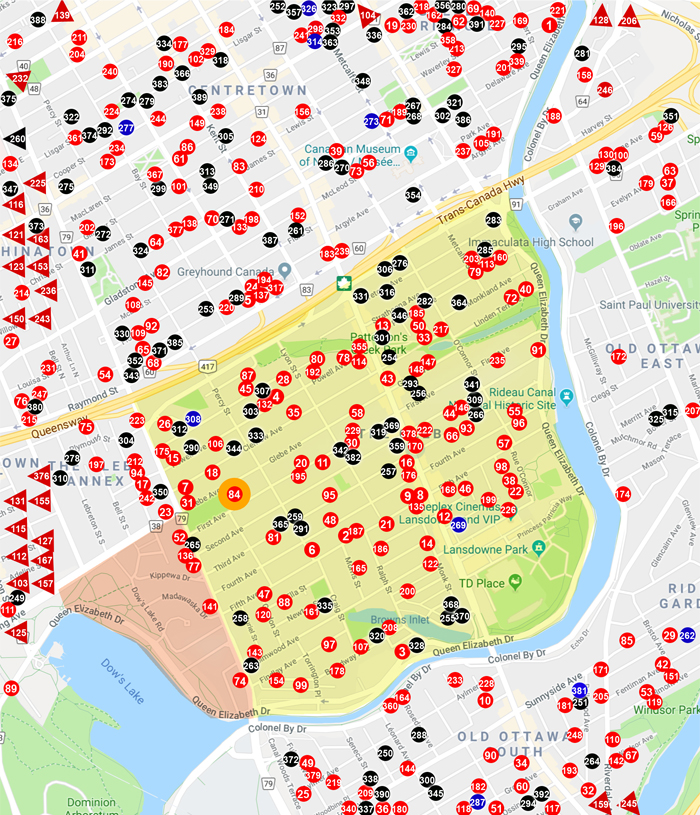
Each pin on the map represents the home of the fallen’s next-of-kin. For the most part, this meant the parental home or the marital home (the apartment shared with a wife), but in a few cases, where parents were deceased, this could mean the home of a grandparent, uncle or even sibling. I used only addresses that were mentioned in Casualty Lists or as reported in the daily broadsheet newspapers.
The 392 men I was able to put on my map represent only a tiny fraction of the men and women who died in the war. But among these 392 names I found the complete picture of the war as it affected my country. There were men who died in the opening hours of the war and men who died in the closing days. There were men who died on Valentine’s Day, D-Day, Canada Day, Remembrance Day, Christmas Day and New Year’s Day. Most died on active service and in combat, but some died of disease and even murder. There were men who died in car accidents overseas and training accidents in Canada. Every major battle that Canadians were involved in is represented by someone in this group—The Battle of the Atlantic, the Battle of France, the Battle of Britain, Battle of Hong Kong, of Ortona, of Monte Cassino, of El Alamein, of Anzio, of the Scheldt Estuary, the Dieppe Raid, Dam Busters Raid, D-Day, Battle for Caen, Battle of the Falaise Pocket, the Siege of Malta, the North African Campaign, the Conquest of Sicily, the Aleutian Campaign, Bomber Command, Fighter Command, Coastal Command, Transport Command, the British Commonwealth Air Training Plan, Burma, Singapore and more. Some were lost in the Mediterranean Sea, the North Sea, the Irish Sea, the Atlantic Ocean and the English Channel. Some died before they could get to the war, others on their way to the war. Some died after the war but before they could get home. They are buried in Holland, Italy, Great Britain, Germany, France, Belgium, Canada, North Africa and of course at sea. Many have no known grave and are commemorated on the Runnymede Memorial, the Malta Memorial, the Halifax Memorial, the Bayeux Memorial, the Groesbeek Memorial, and the Ottawa Memorial.
Having scanned every page of the Ottawa Journal and the Ottawa Citizen from September 1939 to September 1945, I learned that Canada was not the idyllic land I once believed it was in the years leading up to and throughout the war years. I had always imagined a world of church-going, clean-living, Saturday-night-dancing, honour-before-all innocence. The kind of honest and forthright world that gave birth to the Greatest Generation. But it was a world that, in many ways, was far bleaker, harder and unkinder than the world we live in today. Right off the bat, I noticed an extraordinary amount of industrial accidents, horrific workplace injuries, train wrecks, car-train collisions, fires, drownings, and accidents due to unsafe practices. As well theft, robbery, assault and murder seemed as or more common than they are today, multiple murders included. Institutionalized soft-core racism prevailed. Decades of government intervention, prevention and education has, in fact, improved things considerably. Yet, despite the cruel world of 1939, everyone in Canada read from the same page, got their news from the same trusted sources and fundamentally believed in the same things.
In the end, I found 392 names of service men who were included on casualty lists and for whom I found an address. I have another 50 or more names of men who I know were killed but I can’t find their addresses. There are, I am convinced others who I haven’t yet found on casualty lists. The 392 are by no means all of the men who died and lived in this area—they are only the ones whose story I found. I welcome any additions and omissions. I am presently working with my web developer to display this data on Google Maps, thus enabling us and you to add to the list and perhaps one day, map all of the approximately 110,000 Canadians who died in wars since the Boer War.
In the 13 years of the War in Afghanistan, Canada lost 158 soldiers and seven civilians. Ask any Canadian and they will tell you it was a terrible price. In the five years of the Second World War my small neighbourhood lost nearly 400. May we never forget them. Here is the map of the devastation felt by my community in the Second World War—the location of each man’s home is shown, followed by their photos. If I found an address but no photo, I used a photo of either their grave stone or the memorial upon which their name is engraved.
This project began as a result of curiosity and then became a Remembrance Day Project that I struggled for months to complete. Sadly, I was still adding names well after the 11th of November. It is now simply an homage to a generation of parents, brothers, sisters, wives and grandparents who carried the terrible weight of sacrifice well into the 21st Century. An homage to the Silver Star Mothers, the broken fathers, the shattered families and the solitary wives. God bless them.
We would like to offer our sincere gratitude to Dave O’Malley, and by extension, Vintage Wings of Canada, for allowing us to republish this important story. To see more of O’Malley’s remarkable work, and to learn more about the remarkable efforts of Vintage Wings of Canada.
Addendum: In the week or so since Dave O’Malley published this story, he has discovered twenty two further men that should be added to the list. He eventually expects the list to top 450 once he has completed his search. Also, for those curious to know why no women were mentioned on this list, this is not for the lack of looking, it is just that so far O’Malley has not found the names of any women from the Glebe who died in military service during WWII. In taking a look myself, I found that more than 50,000 Canadian women served in uniform during WWII, with 83 of them dying during that time (compared to more than 1.1 million men in uniform, of whom over 43,000 died).
We hope you took some time breathing in the volume of names in Dave O’Malley’s piece, and that some of you will write in to share your thoughts…