


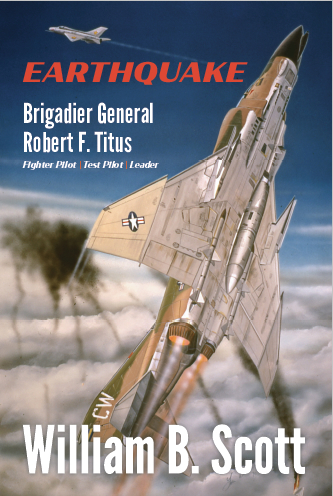
By William B. Scott
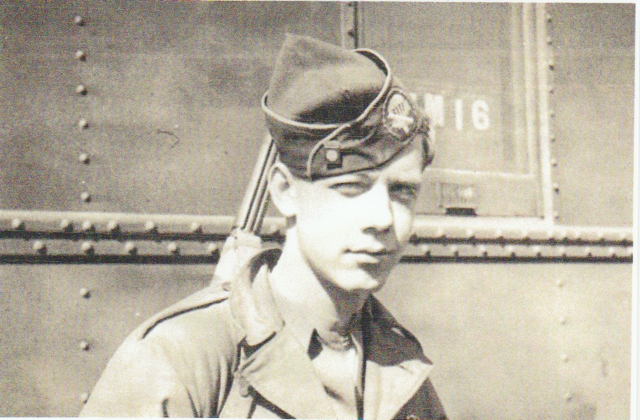
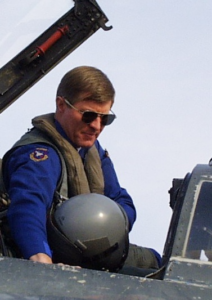
Chances are, you’ve never heard of him. But rarely has an American warrior’s life-story been as varied and engaging as that of Air Force Brigadier General Robert F. Titus. His 32-year military career launched when he joined the U.S. Army on his eighteenth birthday. At the first opportunity, he volunteered for Army paratrooper training, earned his jump wings and was preparing to drop into mainland Japan, when World War II ended.
As a squared-away soldier in the 82nd Airborne Division—designated the All-American Division—Titus marched in the World War II Victory Parade on January 12, 1946. Major General James “Jumpin’ Jim” Gavin led 13,000 men of the 82nd down the streets of New York City. Young Titus was in the front row, leading the left-most column. The Army soon returned thousands of men to civilian life, prompting Titus to resume engineering studies at the Virginia Polytechnic Institute and State University. His life took a sharp turn in the Spring of 1948, when an Air Force recruiter appeared on campus, looking for “guys to go to pilot training,” Titus recalls. He signed up, but wasn’t to be sworn in until September. By then, he had decided mining engineering would never be in his future, so “I didn’t bother to go back [to Virginia Tech] the next quarter.”
Despite a few hiccups in primary training, Titus quickly proved to be an excellent pilot and set his sights on flying the hottest USAF fighter of the day—North American’s F-51 Mustang. But a bizarre dictum forced him into B-25 Mitchell bombers.
“If you were over six-feet tall, you were too tall to fly fighters,” he lamented. Nevertheless, he ultimately wrangled his way into Mustangs and was sent to Korea, after war broke out. Titus flew 101 combat missions in both F-51s and F-86 Sabre fighters, during a particularly dangerous phase. Returning from one mission, his Mustang’s rapidly rising engine temperature forced a low-altitude bailout in No-Man’s Land between friendly and enemy troops. On the ground, he jumped into a shell crater as Chinese soldiers closed on his position. Titus’s revolver clearly was no match for the bad guys’ automatic weapons. Then he heard an American voice say, “Keep your head down and crawl this way.” He was close to a bunker of Marines, who quickly dispatched the enemy.

That was the first of many harrowing experiences that would lead one to believe Bob Titus always had an angel riding on his shoulder. Back in the States, he was assigned to the 1737th Ferrying Squadron, flying F-86 Sabres and F-84 Thunderjets to NATO bases in Europe. Flights across the Northern Atlantic in single-engine fighters were hazardous, at best, as evidenced by pilots being awarded an Air Medal for completing 10 deliveries. Next up: USAF Experimental Test Pilot School at Edwards Air Force Base, California. Even though he had no engineering degree, Titus graduated with Class 54B and joined a cadre of soon-to-be legendary test pilots, who brought Century Series fighters into the Air Force inventory. Ultimately, Titus flight tested every one of them—F-100 Super Sabre, F-102 Delta Dagger, F-104 Starfighter, F-105 Thunderchief, and F-106 Delta Dart—plus a host of other aircraft and weapon systems.
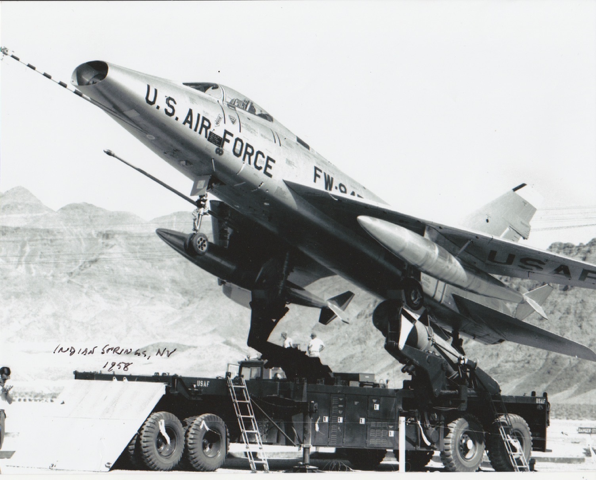
The 1950s and early 1960s were dubbed the “Golden Age of Flight Test,” but fatal accidents killed a staggering number of Edwards test pilots. Today, numerous streets across the sprawling desert base bear the names of those pilots. By chance, Titus flight tested a rocket-boosted F-86, which was intended to enable the Sabre going supersonic in level flight. Consequently, he was the logical Air Force project pilot to fly the heavier Super Sabre equipped with a rocket. He flew 10 test flights of the “Zero Launch F-100” or ZEL system to evaluate the feasibility of dispersing fighters in the event of nuclear war. With a Rocketdyne solid-propellant booster strapped to an F-100D’s belly, the aircraft would be loaded onto a trailer and elevated to a 20-degree nose-up angle, enabling fighter launches from myriad concealed sites.
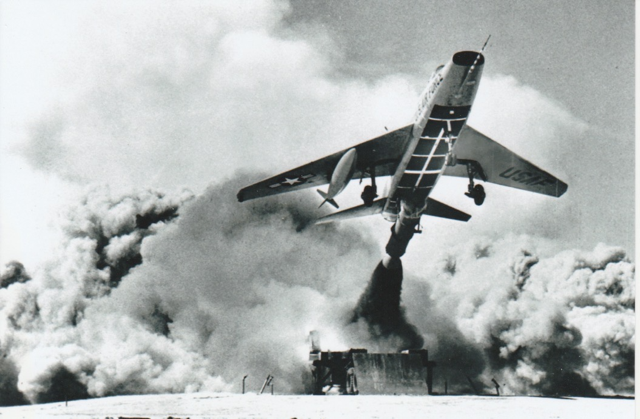
“It was pretty simple, actually,” Titus said. “You get into the cockpit…crank up the engine…and go to the afterburner. Then you pull the trigger and off you go. You accelerate from zero to 275 miles per hour in four seconds and the [rocket] booster falls off.” Or it was supposed to. On one occasion, the rocket-release system failed, forcing a contractor test pilot to eject. There was no way to safely land with the rocket attached.
After that program ended, Titus was tasked to find a mission for a couple of two-seat F-100s. That led to “Operation Julius Caesar,” which demonstrated that fighters could be flown nonstop over the North Pole. Brigadier General Charles Blair, Titus and a couple of back-seat pilots ferried two Super Sabres from England to Alaska. The nine-hour, record-setting flight required three inflight refuelings and navigation procedures that Titus had developed. Titus subsequently attended the University of Chicago to obtain a Masters in Business Administration degree and flew F-105 Thunderchief fighters in Europe, before being assigned to USAF Tactical Air Command headquarters as the chief of Fighter Operations Branch. Brigadier General Gordon Graham charged the talented fighter pilot to formulate the general operational requirement (GOR) for what became the “FX,” a concept that evolved into the F-15 Eagle air superiority fighter program.
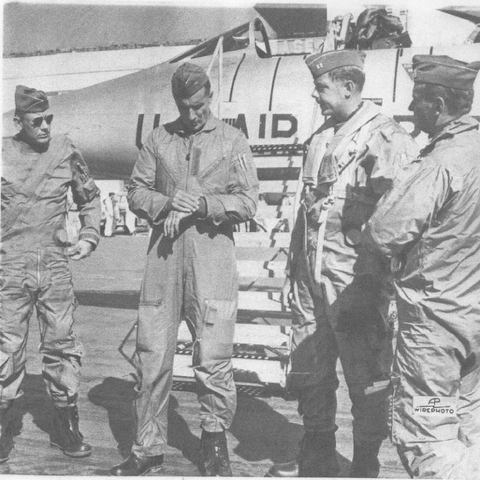
During this period, “Gordy” Graham once yelled across the hallway, “Send ‘Earthquake’ over here!” His spontaneous reference to tectonic Earth movement was immediately adopted as then-Major Titus’s call sign, a moniker he never liked, but was deemed appropriate by those who knew the deep-voiced, brash officer. Titus continued to advance rapidly through the ranks as commander of various units, including the “Skoshi Tigers”, a squadron of Northrop F-5 Freedom Fighters. As first to command the 10th Fighter Commando Squadron at Bien Hoa, Vietnam, Titus flew more than 350 air combat missions and earned his third Distinguished Flying Cross. Somehow, he “forgot” to log at least 50 of those missions.
In January 1967, Titus took command of an F-4C Phantom squadron at Da Nang Air Base, South Vietnam. It didn’t take him long to whip the fighter unit into shape and determine which pilots were true air warriors. “I wanted hard-core guys who wanted to ‘go North’!” he barked. In the skies over North Vietnam, he and several of those “hard-core guys” would tangle with enemy MiG aircraft and achieve the pinnacle of fighter-flying. Titus bagged his first MiG-21 on May 20, 1967, while escorting a large force of F-105 fighter-bombers to targets in North Vietnam. Chasing an enemy aircraft, Titus and his back-seater, Captain Milan Zimer, fired two AIM-7 Sparrow missiles—and both failed to guide properly.
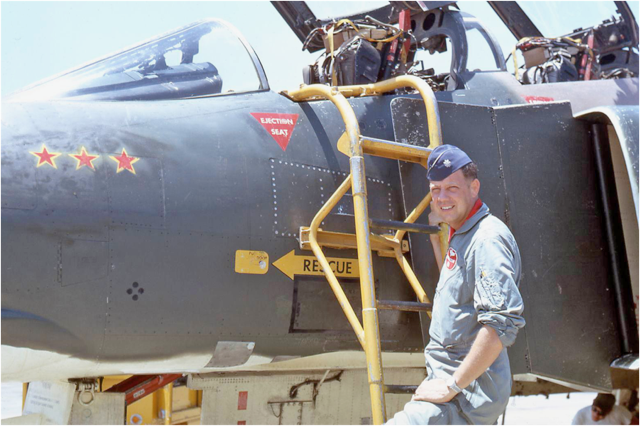
“I thought I was going to have to ram this guy!” Titus growled. He fired a third Sparrow and it hit the MiG-21’s wing root. When the pilot ejected, Titus whooped, “Yahoo! I got that son-of-a-bitch! Yes, it was exciting. I’d been wanting to shoot down enemy airplanes since I was a kid!” Two days later, Titus led two flights of Phantoms escorting heavily loaded F-105s, when the formation was attacked by several MiG fighters. He shot down the first with a heat-seeking Sidewinder, then went after a second MiG-21 as it dived for the ground. “I couldn’t get a lock-on with a Sidewinder,” Titus said. “I was aware of a lot of flak, but I wouldn’t let that intrude on my activity.”
Ignoring a surface-to-air missile that forced Zimer to duck his head, “because the missile appeared that close,” Titus closed on the MiG, maneuvering at very low altitude. “As [the MiG] started a pull-up, I put the pipper at his twelve o’clock…pulled the trigger and let him fly through [a string of 20-mm rounds]. Ran a buzz saw through him.” That was Titus’s third MiG-21 kill in two days, this time with a centerline-mounted 20-mm gun pod. He was awarded a Silver Star for downing the first MiG and the Air Force Cross for numbers two and three.
With more than 550 combat missions to his credit, Titus was assigned to USAF Headquarters and charged with bringing the F-15 Eagle into the inventory. He had to battle a “Missile Mafia” of senior officers who discounted the value of guns in air combat, but succeeded in having the Mach 2 fighter delivered with an internal 20-mm cannon. Those bureaucratic “gunfights” cost him a couple more stars, but Titus smiles and says, “But every Air Force fighter since [the 1970s] has had a gun.” He later commanded the 18th Tactical Fighter Wing in Okinawa, served in several staff assignments and retired as a brigadier general in 1977. “Earthquake” continued to serve, though, mentoring countless Air Force Academy cadets, who learned to lead by example from one of the Air Force’s preeminent commanders. At age 97, “Earthquake” is still engaged with friends, church and family.
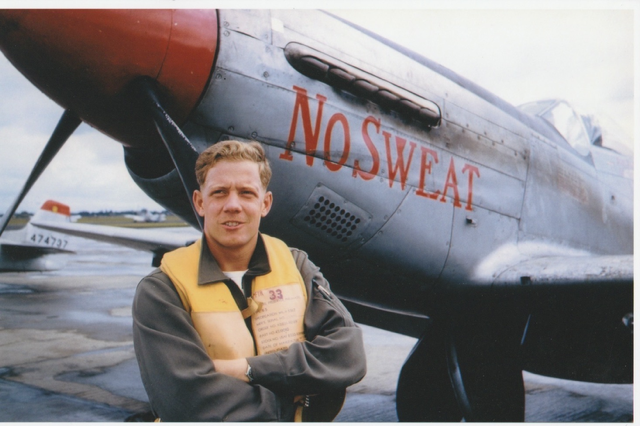
Back in mid-March, 2015 we published a story about the last official USAF P-51 Mustang flight which took place on April 15th, 1955 with pilot Robert F. ‘Earthquake’ Titus at the controls (click HERE for the story). A California man, Leon DeLisle, wished to commemorate this significant occasion by recreating that final Mustang mission with ‘Earthquake’ Titus again in the cockpit of another P-51, and organized an event worthy of the moment. DeLisle created a website HERE to help publicize the tribute and help raise funds for the flight itself. It was quite a grand affair too with two days of celebrations over the weekend of April 18th/19th in Petaluma, California. The City of Petaluma even went so far as to declare April 18th officially as “Earthquake Titus Day”!
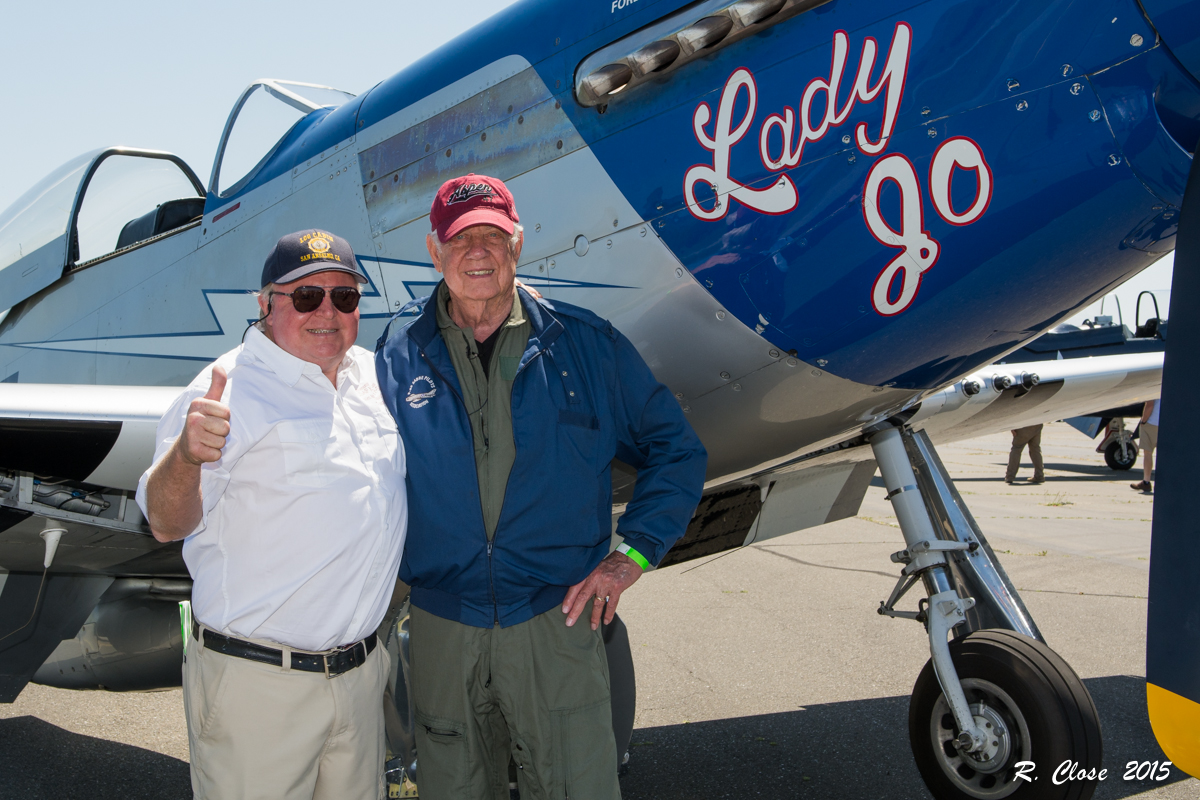
Read his incredible stories in his own words, as told to author Bill Scott, who sat down with the legend for multiple interviews to learn how it really was.
William B. Scott is the former Rocky Mountain Bureau Chief for Aviation Week & Space Technology magazine and author/coauthor of seven books. A Flight Test Engineer graduate of the U.S. Air Force Test Pilot School, he’s logged approximately 2,000 flight hours on 81 types of aircraft and holds a BS degree in Electrical Engineering.




he passed away
….on 8 Sept. 2024.