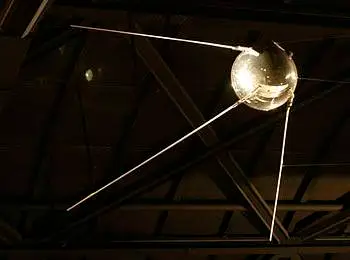






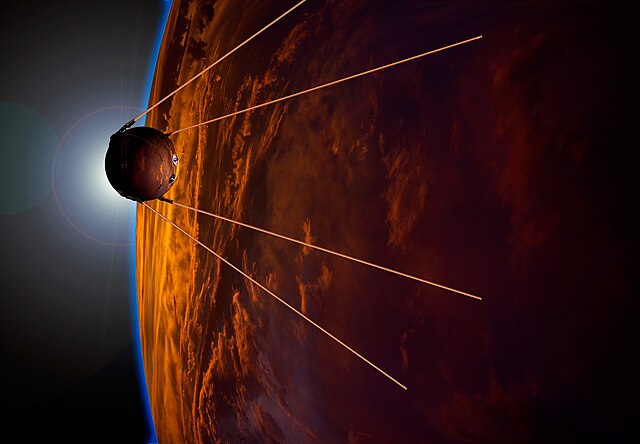


Sixty-eight years ago today, on October 4, 1957, the Soviet Union launched Sputnik 1, the world’s first artificial satellite, into orbit. Once in space, Sputnik transmitted a continuous radio signal back to Earth for three weeks until its three silver-zinc batteries were depleted. The satellite remained in low-Earth orbit until January 4, 1958, when atmospheric drag caused it to reenter the atmosphere.
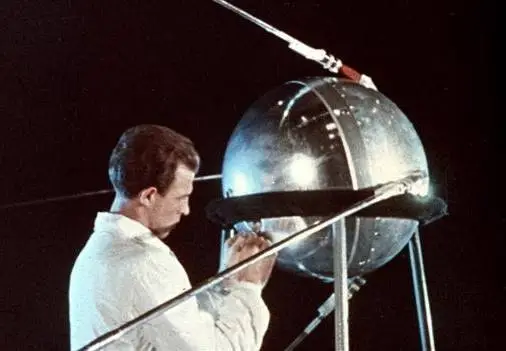
Sputnik 1 lifted off from Tyuratam, Kazakh S.S.R. (now the Baikonur Cosmodrome) at 22:28:34 Moscow time. The spacecraft was carried by a two-stage Sputnik 8K71PS rocket, a derivative of the R-7 Semyorka intercontinental ballistic missile. In orbit, the satellite completed a full revolution around Earth every 96.2 minutes. The satellite was designed and built by the Soviet government’s Experimental Design Bureau-1 (OKB-1) in collaboration with the Ministry of Radiotechnical Industry. Leading the project were engineers Mikhail Stepanovich Khomyakov, Maksim Khramov, and Oleg Genrikhovich Ivanovsky. While primarily a technological demonstration, Sputnik 1 also served as a symbolic warning to the West, catching the United States by surprise and spurring the beginning of the Space Race.
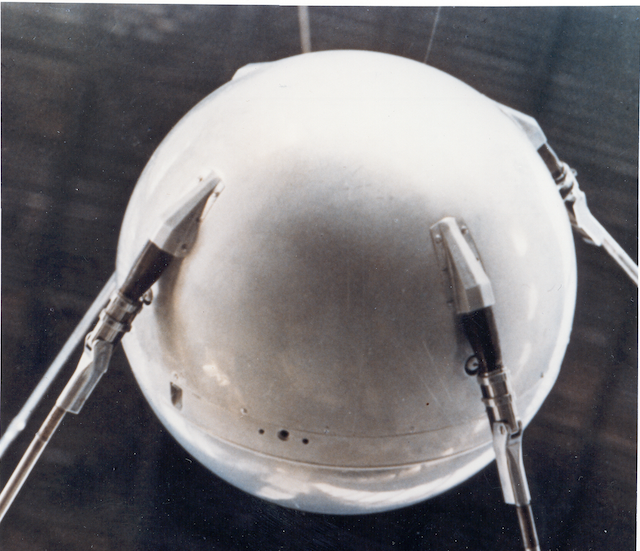
Sputnik 1 was a polished metal sphere measuring 58 centimeters (23 inches) in diameter and weighing 83.6 kilograms (184 pounds). It was powered by 1 watt and carried two radio transmitters operating at 20.005 MHz and 40.002 MHz. While the media commonly referred to the spacecraft simply as “Sputnik,” its official technical designation is Satellite-One. The launch of Sputnik 1 marked a milestone in human history, demonstrating the feasibility of orbital spaceflight and forever changing the course of global science and technology.