




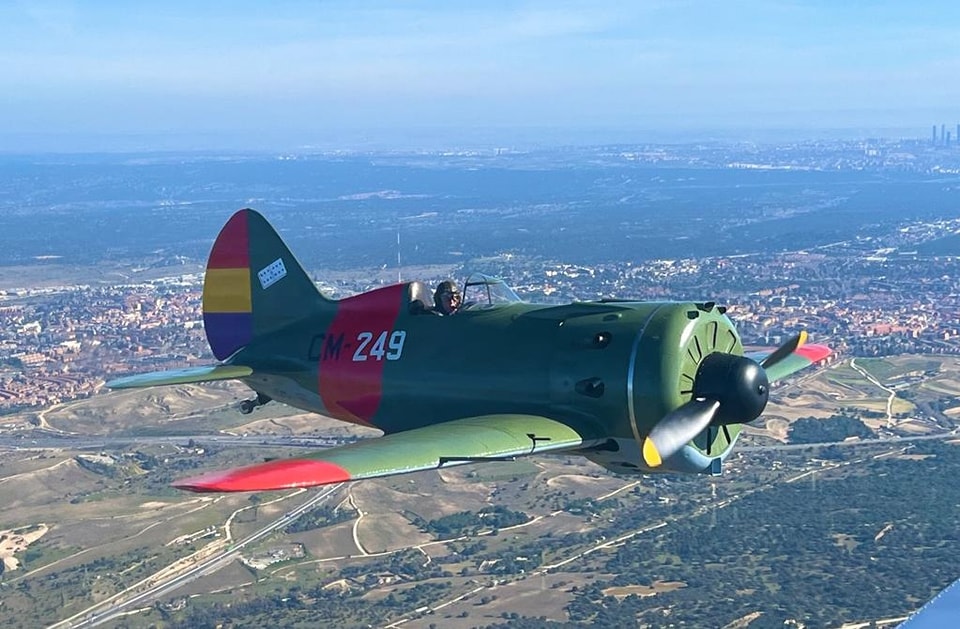

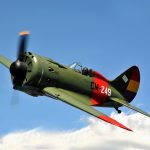
After four years on the ground the Spanish Air Force-schemed Polikarpov I-16 “Rata”, operated by the Foundacion Infante de Orleans (FIO), flew again for the public on Sunday, February 4, 2024, during the EXHIBICIONES DE VUELO 2024. After a successful test flight on December 30th, the rare aircraft was highlighted this last Sunday along with the museum’s collection of vintage and warbird airplanes.
The FIO is the Spanish historic aviation flying museum, a non-profit organization formed by a group of aviation enthusiasts and pilots at Cuatro Vientos Airport near Madrid in 1989 for the sole purpose of preserving and sharing Spanish aviation history. They named it in honor of Don Alfonso de Orleans y Borbon (1886-1975) a famous Spanish pilot and aviation pioneer. The FIO set out to retrieve and restore aircraft with a significant place in Spain’s aeronautical heritage and the collection now has around 38 airworthy planes, spanning more than 70 years of Spanish aviation culture. They maintain them in their workshop and exhibit their collection to the public once a month with an air display from their home base. One of their most important artifacts is an airworthy Polikarpov I-16 “Rata”, and that is the focus of this article.
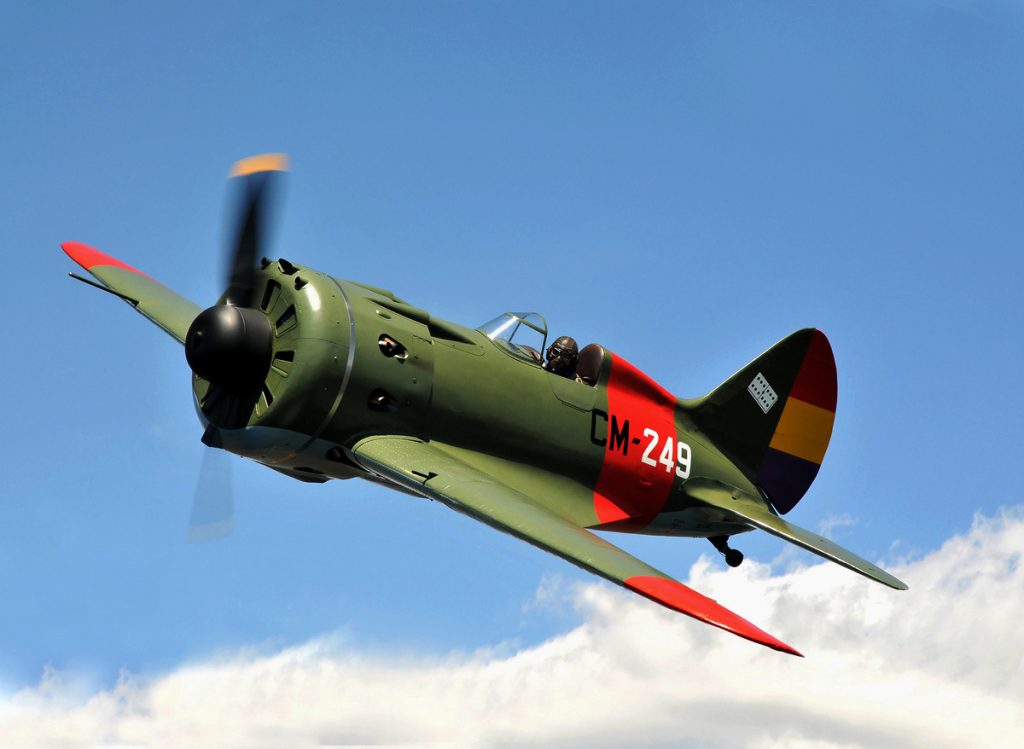
The Polikarpov I-16 is one of the most unsung aircraft in history, almost the Rodney Dangerfield of fighters, getting no respect from anyone – except its opponents. Created by Russian designer Nikolai Nikolayevich Polikarpov, this classic airplane was a brilliant leap forward, particularly for a Soviet aviation industry that was still in its infancy. Production of the I-16 ended in 1940, but it was quickly resumed after the Nazi invasion of the Soviet Union in 1941. It was not only the first cantilever monoplane fighter with retractable landing gear to see squadron service in any country in the world, it also was one of the longest-lived fighters of the period, serving until as late as 1950 in Spain. It received many nicknames including “Ishak” (‘little donkey’) in Russian, and “Rata” (‘rat’) and “Mosca” (‘fly’) in Spanish.
In the early 1990s, New Zealander the late Tim Wallis (later Sir Tim) contracted the Aeronautical Research Bureau of Novosibirsk to remanufacture six examples of the I-16 from wrecks discovered around Russia for his Alpine Fighter Collection based at Wanaka. As soon as the FIO heard this, they launched a campaign to bring one to Spain. A lot of people supported the project, however it was only with the support of the Getafe City Council that they achieved their goal. Getafe signed an agreement with FIO to build a new museum and to finance part of the “Rata” acquisition. After negotiation, the FIO acquired their I-16 for €262,000 and it arrived in Spain in early 2005. The FIO’s example is based upon the remains of an example found in 1992 near Lake Kokkojarvi in Karelia, a region of northern Russia bordering Finland. Manufactured in 1937, it belonged to 122 Squadron of the Soviet Northern Fleet.
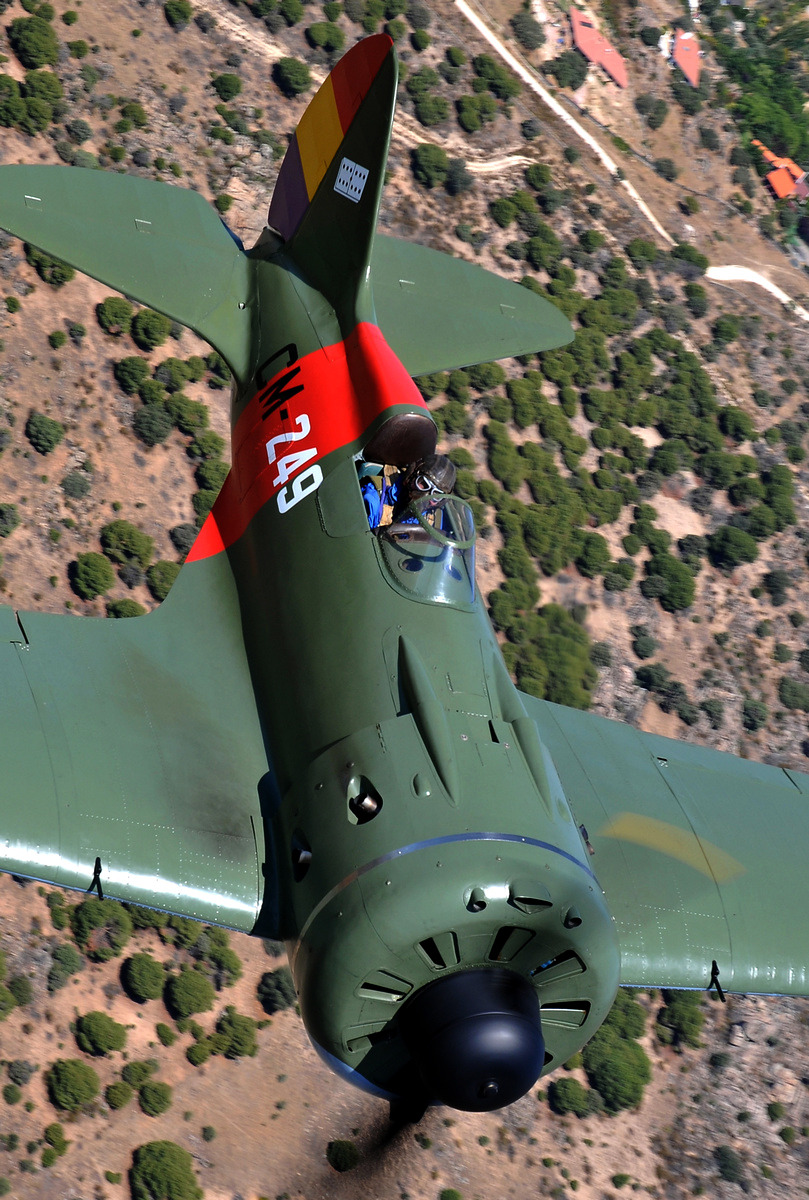
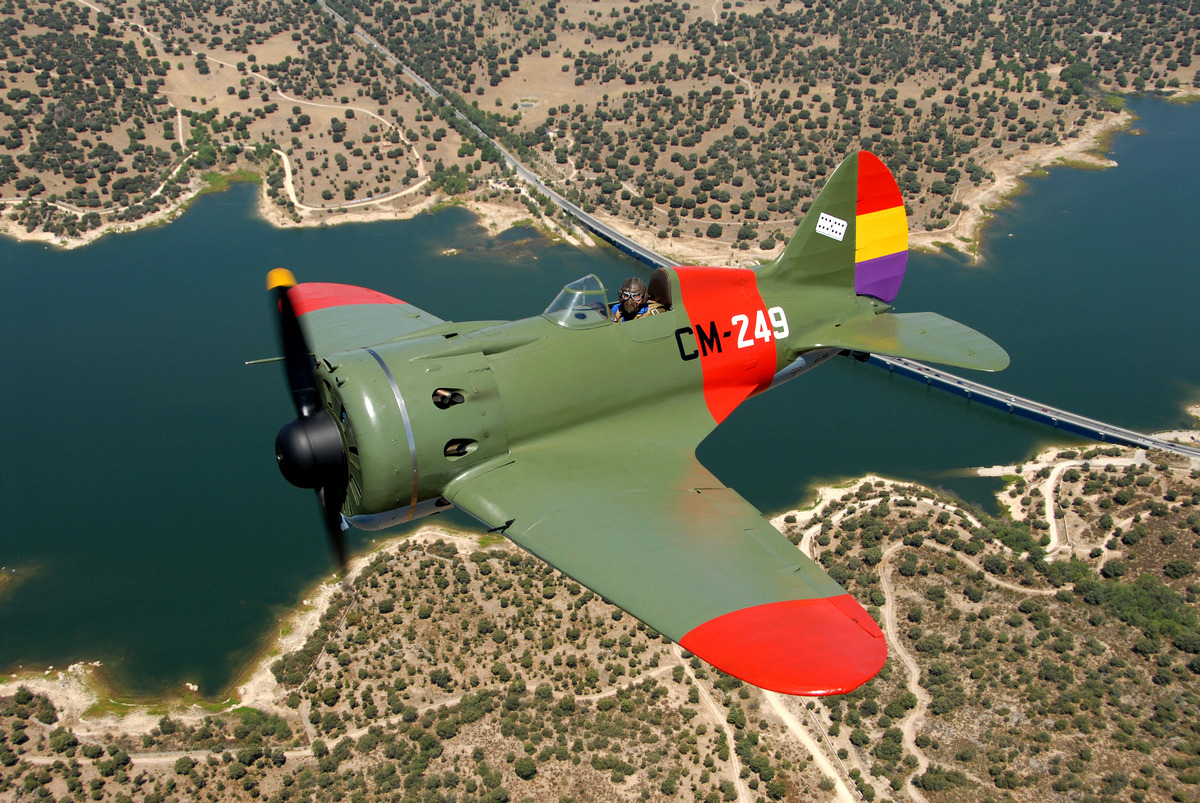
The FIO’s I-16 made its maiden post-restoration flight in 1997, and its official public debut in Spain came on May 4th, 2008. The plane is marked as CM-249, a “Super Mosca” flown by Captain José María Bravo, commanding officer for 3 Escuadrilla. Although this was Captain Bravo’s plane, as the white squadron leader’s code numbers indicate, Sgt. J. L. Tarazonait also flew it on occasion. The 3ª Escuadrilla ‘Moscas’ formed in 1937, commanded by a Russian, Boris Smirnov. The Esquadrilla fought during the Battle of Guadalajara and later in the Battle of Segovia and had two further Russian commanders, Ukhov and Yevseviev, during the Battle of Brunete. After reuniting with 2ª Escuadrilla, the planes fought during the Battles of Belchite and Teruel. After this last battle, the 3rd Esquadrilla received a Spanish commander named José María Bravo in Salou in March 1938. He led them through various aerial battles until the unit was disbanded in February 1939 after the Battle of Ebro.
The Polikarpov I-16 had made its last flight during closed-door training in the middle of the COVID-19 pandemic in December 2020. Currently the FIO’s intention is to continue keeping it operational, participating in the foundation’s monthly expeditions. The test pilot and regular pilot of the aircraft at the exhibitions is Carlos Valle Torralbo, who is also president of the FIO.
The FIO’s one-day event on February 4th turned out to be a very successful aerial display featuring examples of the Dornier Do-27, T-45 Swallow, British Eagle II, De Havilland Canada DHC-1 Chipmunk, Stinson 108, Jodel D119S, SIAI-Marchetti SF-205, Bücker Bü-133L, Miles Falcon Six, Focke Wulf Fw-44 Stieglitz, Boeing Stearman, Fleet 2, De Havilland DH.60 Moth, Polikarpov Po-2, Bücker Bü 133, Bücker Bü 131, Polikarpov I-16, North American T-6 Texan, Beechcraft T-34 Mentor, and Beechcraft C-45.
Despite its odd look and characteristics, the “Rata” is something special, partly for its performance but also for its important history in Spain, allowing the FIO to be extremely proud to keep this important machine flying honoring Spanish aviation heritage.
For more information about the Foundacion Infante de Orleans, visit www.fio.es



 Vintage Aviation News
If they weren’t a collection of over-the-hill Spanish Falangists (Don Alfonso of Orleans and Bourbon was a notable Spanish Fascist), they would call the airplane by its real name “Mosca” (Fly).
I saw the Rata fleet flying at Wanaka last century. Spectacular and sounding like a flock of demented tractors ripping passed.